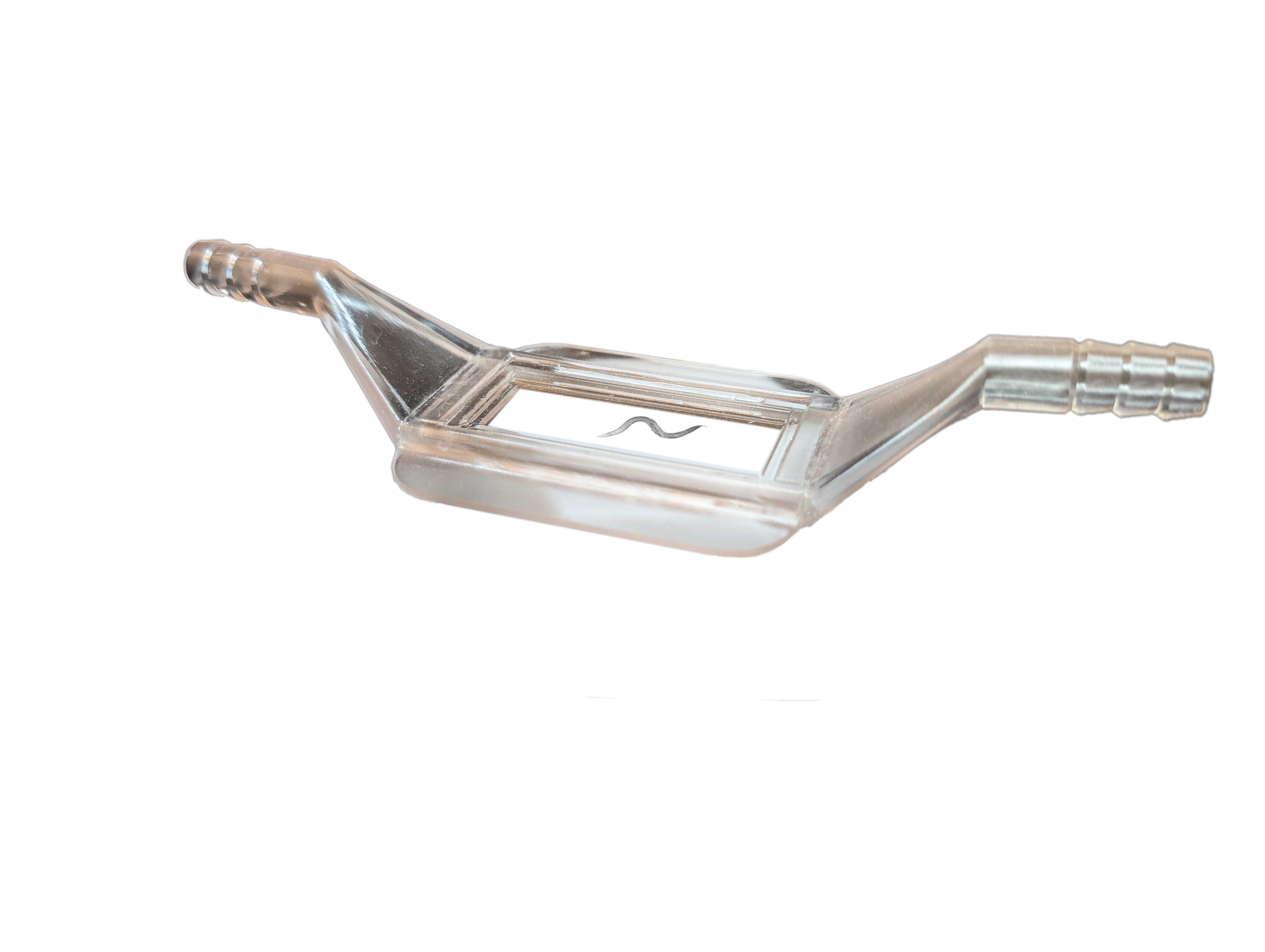
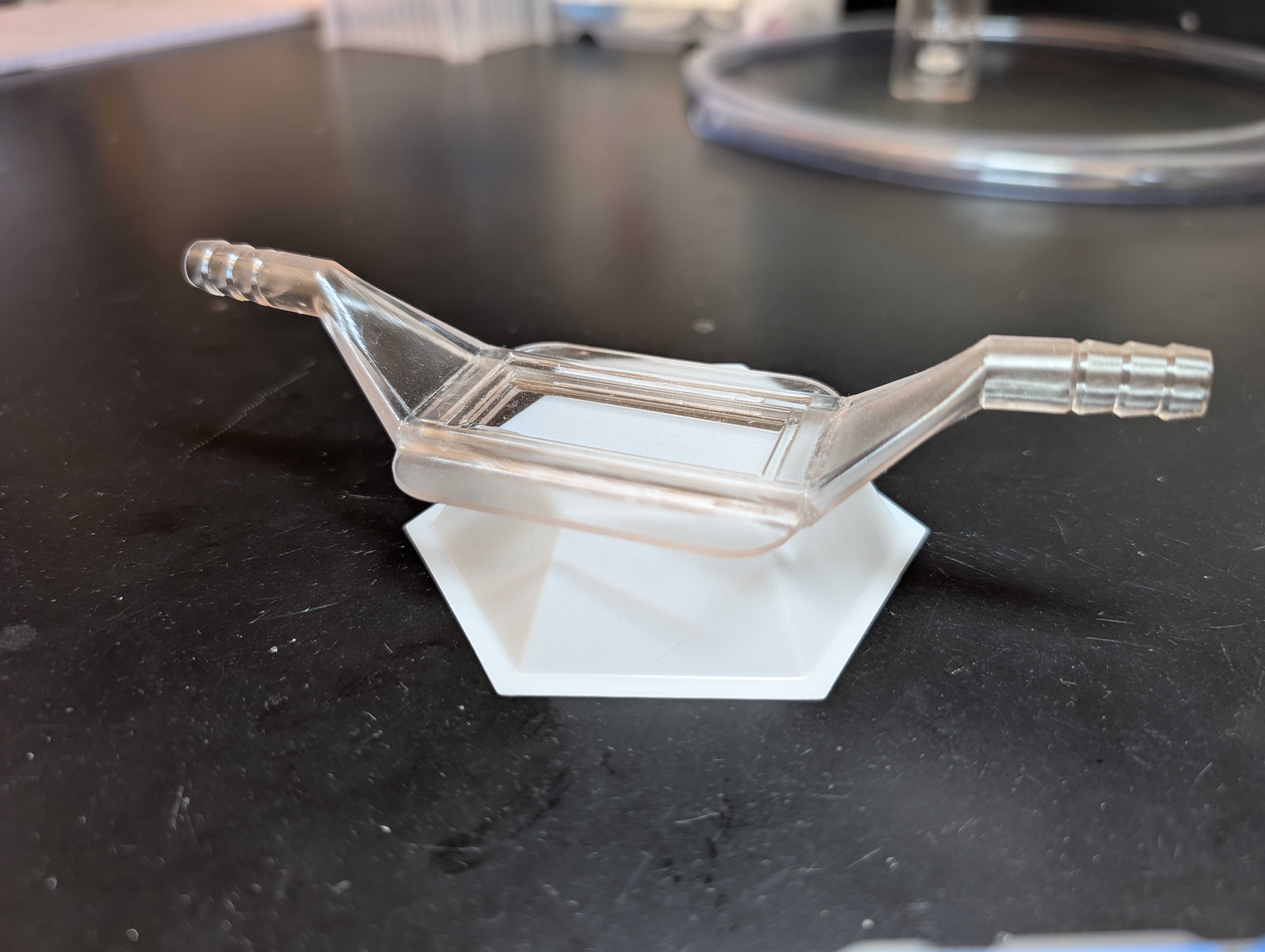
With the latest version of our cooling system, it can cool down to ~12°C, but is operated at a steady 15°C. From there, if the laser heats to 22° and is then turned off, it only takes 4 seconds to cool to 19°. This is more that sufficient as C. elegans perform best in gradients of 0.5-1.5 C/cm and take a few seconds to move a millimeter. They are usually kept at 20°C, so this is perfect for naturalist experiments.
Importantly, the design achieves this while fulfilling the many requirements imposed by our imaging and heating systems:
- Not interfering with the confocal imaging path (lasers & camera FOV)
- Not interfering with the near infra-red tracking path (LED and camera)
- Not interfering with any of the wavelengths used in those paths
- Not interfering with the NIR stimulation (heating) laser
- Not interfering with the worm's environment or movement
- Not interfering with the movement of the stage
- Physically fit on the microscope
To achieve these, the system involves a reference thermistor, sitting out of the way of the worm, as well as a pump, which transports a specifically chosen heat transfer fluid across the cooling device. That device has been optimized to prioritize even cooling (i.e. that the inflow side and center are not significantly colder than the outflow and edges, as tends to happen). The coolant, motor, and device geometry have each gone through many iterations; even the materials of the slide have been optimized, using sapphire for its superior thermal conductivity over glass.
This setup also fulfills two practical requirements from the experimental side:
- Hold a consistent temperature
- Impose no or a mild thermal gradient
This last point is important, as the cooling setup creates its own ambient temperature gradient which needs to be accounted for.
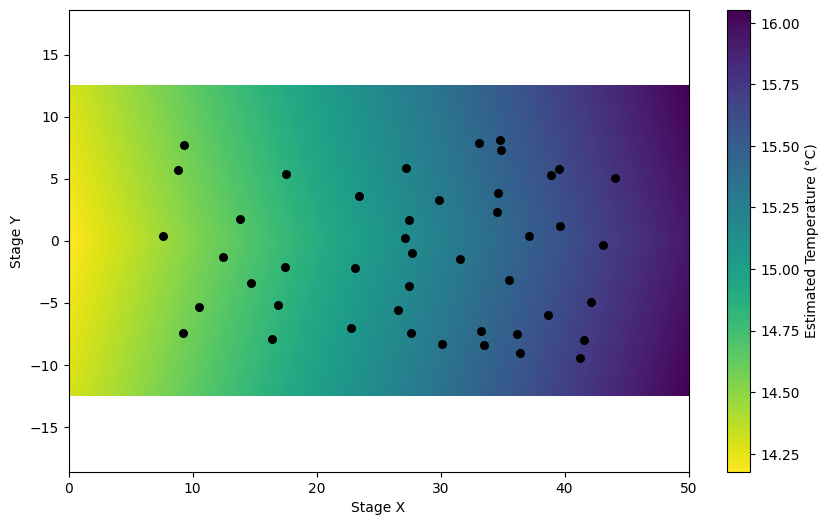
Sampling of the gradient on multiple days shows a remarkably consistent gradient. This simple linear model is accurate to ~0.1°C for the average sample.
However, how have I gotten these measurements? How can we be sure we're actually capturing temperatures experienced by a mm-long nematode?
Measurement
A quick online search will show that small thermistors are quite numerous and affordable. Problem solved!
Unfortunately, thermistors have significantly different IR-absorbing properties than the agar gel our nematodes live on (or the worms themselves). A solid block of plastic or ceramic is going to overshoot the experienced temperature. Likewise, setting a thermistor just outside of the laser radius is going to undershoot (something confirmed after an unfortunate amount of experimenting and debugging). Thus, we need another approach: thermosensitive dyes.
Using these dyes allows us to minimally change the absorbance of our medium, get highly precise temperatures, and even select the specific z-plane we're measuring temperature in, not just xy location. Although getting the dyes working precisely was rather difficult, now that we have them working accurately and reproducibly, we can get much more accurate thermal measurements. These measurements can then be backed up by experimentation. Given C. elegans well-characterized heat shock response, we can demonstrate our precise control over their perceived temperature. Additional gradient and thermogenetic experiments can reinforce this claim if needed.
The Future
Once our environmental control is established, we will be able to perform previously impossible experiments to tackle biologically, neurologically, and computationally interesting questions! Some of the things we'd be able to test are:
- How C. elegans brains integrate sensory information across varied time periods
- How they process such little information to make highly correct reorientation decisions
- How they update internal models in response to a changing environment
- How they react to thermal input decoupled from their actual movement
- How they react to impossible environments (existence of physics-based neural priors)
- (With ACLL) How do they react differently to sensor inputs depending on neural state?
- (With ACLL) Can we manipulate sensory inputs to recreate the exact same neural activity
- (With ACLL) Can they be coached to learn internal states (keeping a neuron high)